
| CCSN Philosophy 102
Reasoning and Critical Thinking Spring 2000 Semester Tues & Thurs sections, 6 pm -- 8:50 pm Rm. C209, W. Charleston Campus |
In short we will learn how to think, write, and speak more clearly in defense of our positions on important issues, and will learn how to fully and honestly evaluate the claims of others. Our goal is to become skillful decisionmakers. It is an important goal.
Each student will also pick an "issue" topic for an original semester paper in which you research the arguments and defend a position in a clear, sound manner consistent with the principles we will be learning. It will of appropriate length and documentation. The paper evaluation will comprise an additional 30% of the final grade. Your semester paper will be due no later than Friday May 12th.
The remaining 10% of your grade will come from homework assignments turned in on time (TBA, with ample notice).
I will adhere to CCSN's published grading policy. See
http://www.ccsn.nevada.edu/resources/facultystaff/handbooks/AdjHandbook/I2.html
http://www.ccsn.nevada.edu/hr/psh/psh03.html#3.2 FACULTY RIGHTS AND RESPONSIBILITIES
I am here to serve you. To the extent you all earn "A's" I succeed. For that to happen, we will all have to collaborate and work hard. I will try to ensure that we have fun along the way.
Dealing with numerical/statistical data:
Probabilities in Everyday Life, by John D. McGervey
How to tell the liars from the statisticians, by Robert Hooke
Elementary Concepts in Statistics, a comprehensive online tutorial on statistics (downloadable w/out charge, too. From StatSoft -- uses frames, BTW.)
Below are links to some of the "search-the-search engines" sites, which take your queries and send them out through various major search engines, web directories, and/or newswire sources in one pass, saving you the trouble of searching one-by-one. TIP: try repeated searches using the same keyword(s) or phrases, because variations in the amount of internet traffic congestion will lead to variations in search results (the search engines all contain "timeout" cutoffs).
Update, 2/4/2000:
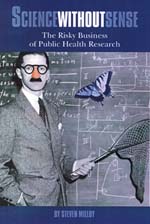
I'd thought Steve Milloy's cool book "Science
Without Sense" had been taken offline (it's for sale in hardcopy), but
no !!! Here it is. Very funny and very insightful. Check it out (click
the pic).
Two more very useful critical thinking websites:
What have we covered thus far?
Week One:
Given that I'd just been handed the textbook 15 minutes prior to convening the first class, after being asked to come in to take the position at 3:30 that afternoon, I first spoke about my background and its connection to reason & critical thinking. We discussed in broad terms the concepts of how we reason, noting that there are essentially two methods:
"Probability" is that branch of math dealing with assessing degrees of uncertainty. Probabilities range from zero ("cannnot happen") to one ("must happen"). Probability is frequently expressed in terms of percentages.
"A Priori" probability deals with fixed alternative outcomes (e.g., the coin toss or roll of the dice), whereas "empirical" probability focuses on data from prior events with which we make decisions about the future (e.g., "30% chance of rain tomorrow; "0.0000001 average risk of your dying in a plane crash.").
We discussed the many ways in which we reason incorrectly with "data", how we misperceive relative risks and benefits. Casino games are the obvious example familiar to Nevadans.
With respect to "deductive" logic, a couple of examples should suffice for now:
If X = 6 and Y = 9, and if Z = X + 2 times Y, then Z must = 24.In sum, "arguments" are simply assertions of facts that are perhaps in dispute (i.e., there's an "issue" to be resolved constructively). Some argument statements are "premises" that provide the evidence for "conclusions." All complex arguments simply consist of chains of premises and conclusions. It is important to note that some premises are often "unstated." In other words they are "assumptions," and if our assumptions are untrue or doubtful, our conclusions may not hold regardless of whatever explicit premises we may state.To be elected U.S. President, one must minimally be 35 years old and a natural born U.S. citizen.
William J. Clinton is the current U.S. President.
(therefore) Mr. Clinton is has to be at least 35 years old and a natural born U.S. citizen.
Week Two:
A review of Chapter One and overview of Two -- the essentials of arguments and reasoning, and clarity in writing.
Arguments involve statements that are "truth claims". Truth claims can be evaluated for truth or falsehood -- though we may sometimes have to decide that we lack sufficient evidence to declare truth/falsehood.
Pure "opinion," on the other hand, refers to statements of personal preference or belief having no basis in independently confirmable facts. "Prejudice" falls into this category, and usually has a negative connotation.
While indeed "everyone has the right to his/her own opinion," not all opinions are of equal worth. Moreover, we all have a responsibility to honestly evaluate our opinions for their rationality.
Week Three:
Effective argumentative writing: Clarity, Organization & Focus, Logical Flow, and Comprehensiveness.
These components all work together (or clash). You cannot be clear if your writing is unfocused and does not flow logically. If you leave significant elements out (poor comprehensiveness), clarity will also be lost. Deliberate organization helps you assure that you include all necessary parts of your argument.. Logical flow is both a function of the premise-conclusion chains and your use of clearly defined terms -- and proper grammar and puncutation.
The best written pieces are rewritten pieces. Draft and re-draft; read your work aloud; get outside opinions. Cut out unnecessary verbiage, redundancies, repetition, etc.
"Definition:" Much poor reasoning is partially the result of the use of poorly defined words or terms used for their emotional value ("connotations") in a way having nothing to do with factual evidence.
Some key concepts:
We can define terms via analogy, by specific example(s), through synonyms, by comparative analysis, or by quantitative specifications.
We also discussed types of ambiguity: semantic, syntactical, and grouping, as well as fallacies of composition and division.
A review of the diagnostic writing sample submissions indicates that many of the P102 students need a LOT of help with grammar and punctuation. The good news, however, is that many of you have offered essentially sound arguments regarding the issues you chose. I will be grading the semester papers primarily (though not exclusively) on the quality of your reasoning, i.e., your logic, your honesty & fairness, and the strength of your independent evidence. While clear and forceful writing helps significantly, this is not an English class.
Having said that, I have to also warn that a paper riddled with misspellings, inflammatory language, poor punctuation, sentence fragments and other grammatical errors, will have no chance at an "A" notwithstanding a perhaps otherwise sound argument.
Week Four:
Chapter 3 concerned the methods we all intuitively use to evaluate informational claims: [1] personal direct observation; [2] background knowledge, and; [3] external sources of "expertise" (including individual "experts" and various media resources). As the book points out, and as we discussed in class, there are limitations in all three areas. Eyewitnesses have been repeatedly proven to be wrong. Humans all once "knew" that the earth was flat, and later that the sun and planets revolved around our planet, and so on. Finally, "expert" information may not always be reliable either. A true expert in one area may be clueless in others. Commercial media also often mislead us (often citing the opinions of "experts") in pursuit of profitable stories that often get the facts wrong.
Chapter 4: Non-argumentative persuasion, i.e., how we use "loaded" language to persuade, either to augment or to replace factual evidence. For example, the "euphemism" is the "kinder/gentler" synonym, while the "dysphemism" and "epithet" are harsh words used to cast a negative spin on some argument position or person.
The text lists a number of unethical "slanting" techniques we should all be aware of, such as use of stereotypes, innuendo, loaded questions, weasel words & phrases, downplayers, hyperbole, and proof surrogates. We have all seen these used repeatedly in our media and by our politicians and by advertisers. This is really nothing new; we're just so used to them, we become unaware of how they might impact our reasoning.
Advertising has evolved persuasive pseudo-reasoning into a fine art and sophisicated science. We looked at and discussed a number of examples.
Advertisers play on our fears on inadequacy. We'll be more attractive and less vulnerable if we just buy this product. We'll be more "Like Mike." We'll be on the beach in paradise with a sexy companion. We'll be healthier, wealthier, and happier...
Nothing works better than Advil.
Uhh.hh...do they mean that their product is no better than those of their competitors? Or that, if we take no drug at all, we'll feel better than if we take Advil?
Deliberate ambiguity at work. The lawyers won't let 'em make precise claims.
Chapters 5 and 6 deal with a broad range of categories of "pseudoreasoning," which involves appeals to emotion, factual irrelevancies (i.e., claims that may be true, but not relevant to a conclusion), and other persuasive techniques that induce us to draw conclusions without proper factual evidence to support them. The categories are:
Don't hold your breath.
Chapter 7 takes up a lot of space to make a relatively small point -- namely, that often explanations are offered when argument evidence is really needed.
The difference is simply that an argument premise serves to provide evidence of why something is, or should be the case (and we're having to "make the case" or decide whether to accept a conclusion), whereas an explanation provides detail about how or why something is. In the latter instance, the conclusion is not in dispute. The very definition of an "argument", however, is that some conclusion is in dispute, so, often, providing explanations may be irrelevant or otherwise inappropriate.
Just as with argument assertions, explanations may be true, likely ("strong"), indeterminate, unlikely ("weak"), false -- or true but irrelevant. Note in the text the criteria given for evaluating explanations. They are quite similar to criteria for the proper definition of individual words (e.g., specificity, absence of circularity, reliability, etc.).
Recall and review the 3 types of explanations:
Chapter 7 also refers to "justification", which is simply the part of an explanation that is offered to "justify" some phenomenon.
We talked in class about the example of the proposed "Star Wars" nuclear missile defense system advocated during the Ronald Reagan presidency. Recall how the "premises" in support of the policy argument conclusion (that we should build the system) were framed in terms of a detailed present-tense language "explanation" of how the system "works" -- ignoring the fact that it was all drawing board speculation, as no system components had even been built in prototype for testing. The supporters of this system proposal wanted to make it seem as familiar and plausible as possible in order to sell the expensive system to taxpayers, hence the tactic of "explaining" how it "works" -- when it didn't even yet exist.
In Advertising 101 they teach us the basic persuasive writing principle of "present tense, 2nd person singular, active voice." When you view or listen to ads, think about this. See how they "explain" the "benefits you derive" by buying into their argument.
One last item: explanation by analogy. Analogies
are used to explain a word or concept by drawing parallels with others
that have the same or similar attributes but are perhaps more familiar.
While the grades on the midterm were skewed high overall (meaning a large proportion of the students got what would be a "B" or better were I letter-grading it), I am concerned about the range of the scores, which bottomed out at 50% (30 correct out of the 60 that counted). As I promised, you will get another crack at some of the midterm questions that seemed to be troublesome to so many. They will re-appear on the Final Exam as bonus questions, i.e., wrong answers won't count against the 60 points you'd need to "ace" the final.
But, you still have to answer them correctly to pile up additional points.
Remember, we're looking to get as close to 200 total points as possible. The midterm was worth 60, as will be the Final and term paper each, plus about 21 points possible on the argument diagramming homework (which I will grade this week of April 17th).
You need to reflect on what we've been covering in this course and apply the principles to the term paper. Specifically, I will be looking for
The structure of arguments. This was really a re-hash of concepts we covered at the start. All arguments consist of claims of "truth." Nearly all are comprised of chains of premises-to-conclusions. Recall that one conclusion often then becomes a premise for the next conclusion, and so forth.
Some premises are "independent" whereas others are "dependent." The latter are those where two or more premises must both/all be true for the overall premise to support the conclusion. Independent premises are just that -- independent of each other. If one is found to be false, it does not falsify the others which are arguing for a conclusion.
"Valid Arguments" are simply those in which, if the premises are true, the conclusion MUST also be true. A "sound argument" is one which is both valid in form and actually true.
When evaluating argument elements, always remember to think "Because of this...therefore that..."
Chapters 9 & 10:
The less said the better, right? Yeah, highly technical and deadly boring. You will not be tested on this material.
Just remember that formal logic "truth table" principles are in fact useful. They are at the heart of digital computers. All computer circuits consist of "logic gates" which simply evaluate electronic states as "true/false" in the same manner as the truth tables we briefly reviewed.
Hint: bonus question...
"Amphibole" means "ambiguous in a sense. For example, the statement:
"P and Q or R"
Should we evaluate it to mean "(P and Q) or R"? or, "P and (Q or R)"? You can't tell from the original. Computer programs containing amphibolous statements in their code often crash, as the computer's logic gates interpret them differently from the intent of the programmer.
Chapters 11 & 12:
Inductive logic and causal arguments. MOST of the reasoning we have to do throughout our lives involves weighing incomplete evidence and drawing conclusions that might be correct, but maybe not. We're talking about probability now, and arguments that run from very strong to very weak.
Much of the time we're using samples of information ("data") from the past to infer that the same or similar outcome will once again occur, given the similarities of current (or predicted) circumstances to past circumstances. This is "reasoning by analogy" or "empirical reasoning."
Chapter 11 addresses some of the pitfalls, such as insufficient sample size, or biased samples. There's also a good discussion of the problems inherent in "polling," i.e., gathering data by surveys. See in particular pages 373-377. Expect to be tested on these concepts.
Chapter 12, "causal arguments," is really about the "scientific method." We looked at
Chapter 13:
"Moral," legal, and aesthetic reasoning. The last chapter. We'll review it the week after the break. I'll post some thoughts on it during this week.
UPDATE: In the wake of the Elian Gonzales "raid" in Miami on 4/22, we will use the 11 Circuit Appeals Court ruling as a timely example of "legal reasoning."
I've posted it at
http://www.bgladd.com//Phil102/Elian_Asylum_Ruling.html
What are the core issues the Court addressed here?
We will not look at "aesthetic reasoning" much, if at all. The overlapping concepts of "moral" and "legal" reasoning are much more important, given the short time we have remaining in the semester.
What do we mean by "moral"? Can behaviors be neatly placed into categories of "right" vs "wrong"? What are the main historical & philosophical roots of "morality" and "moral reasoning"? Are there fundamental aspects of "morality" that transcend time and cultures? (Yes. Name some.)
Is law always about moral issues? (No, not directly. But, should it be?) Is legal reasoning significantly different from the kind we all do every day? Why the perverse popularity of sarcastic and cynical "lawyer jokes"?
Your final exam will cover chapters 8, 11, 12, and 13, and will have perhaps 20 bonus questions that will include some midterm questions and some random other material taken from things we've discussed in class.
PLEASE COME TO CLASS. Some of you miss a lot of classes. Take it seriously. I want you all to get good grades, but I cannot just give them away. You have to participate, ask questions about unclear things, etc.
Email me anytime.
BG